
Compliant Salary Scales: An Operational Roadmap for Malta’s Equal Pay Mandates
For years, many businesses set pay behind closed doors through casual chats, individual negotiations, or gut feeling. Those days are over. Moving to clear, written salary scales is now a strict legal requirement rather than just good HR practice.
The biggest change comes down to who holds the responsibility. In any pay dispute, the legal burden of proof has flipped: employers must now prove that their pay systems are completely fair and gender-neutral, rather than making workers prove they are being underpaid.
To stay ahead of legal risks, companies must seek proper legal guidance and put documented pay structures in place. This article breaks down how to build compliant salary scales that protect your business under Malta’s new equal pay regulations. We walk through how to evaluate roles by work of equal value, what documentation rules apply to your workforce size, and how to audit your payroll to spot and resolve pay gaps before mandatory reporting deadlines arrive.
Defining Compliant Salary Scales
Grouping Roles by “Work of Equal Value”
A compliant salary scale cannot base pay, directly or indirectly, on a worker’s gender. Instead, businesses must group jobs using the legal standard of “work of equal value”, meaning positions with similar levels of responsibility and effort must receive equal compensation, even if the job titles are completely different.
Companies can choose exactly how they evaluate and score these roles to suit their specific industry and operational needs. A business might use the following four practical pillars as an example of how to build a fair evaluation framework:
- Skills: The practical experience, technical know-how, and interpersonal soft skills needed for the job.
- Effort: The mental focus, physical demands, and emotional energy the work requires.
- Responsibility: The level of autonomy, financial oversight, and impact on business decisions.
- Working Conditions: The day-to-day work environment, physical hazards, psychological factors, and working patterns.
To systematically score and weigh these pillars, organisations typically rely on the point-factor job evaluation method, which assigns numerical values to each factor to establish fair, defensible pay bands.
Crucially, your salary scales cannot just focus on basic wages, they must cover total remuneration. Performance bonuses, commission, allowances and company perks are common areas where pay gaps secretly creep in.
To prevent discretionary perks from turning into equal pay risks, bonus structures must be tied to clear, objective KPIs. Documenting the logic behind performance targets ensures bonuses are applied fairly and gives you solid proof that variable pay is based on merit, not bias.
Setting Clear Rules for Pay Progression
Employees need to understand how they can earn pay rises and move up within their pay band. Your documentation requirements depend directly on your team size under Maltese regulations:
| Workforce Size | What You Must Do |
| 250+ Employees | Must maintain accessible written pay policies and submit annual Gender Pay Gap Reports to DIER. |
| 100–249 Employees | Must maintain accessible written pay policies and submit triennial Gender Pay Gap Reports to DIER. Mandatory pay reporting applies to all organisations exceeding 100 employees. |
| 50+ Employees | Must adopt and maintain written policies that establish the objective, gender-neutral criteria used to determine workers’ pay, pay levels and pay progression. These policies must be accessible to workers at all times. |
| 25–49 Employees | Must internally document the exact criteria used to decide pay rates, job grades and pay rises. |
| Under 25 Employees | Not specifically required to have written progression policies, but still legally bound by equal pay rules. |
If you run a small business with fewer than 25 staff, you are not specifically required to write down formal progression policies. However, the core rule of equal pay for work of equal value still applies to every business in Malta, regardless of size.
If an employee ever challenges their pay before DIER or the Industrial Tribunal, the burden of proof still falls on you. You will have to show that any pay difference is justified using the four core pillars: skills, effort, responsibility and working conditions. For this reason, documenting your pay criteria in writing is considered best practice even for small teams.
Operational Implementation: Standardising Your Pay Architecture
Centralise Your Pay and Role Data
You cannot manage what you do not track. Employers must review their data storage habits and make sure all salary records, job descriptions and pay histories are kept safely on file for at least five years.
Run an Internal Audit to Find Unexplained Gaps
Regular internal checks allow you to spot and fix unfair gaps before they turn into legal headaches:
- The 5% warning line: If an internal pay audit reveals a gender pay gap of 5% or more in any job category, it triggers a mandatory statutory process.
- The 6-Month Window: Employers have 6 months from the Pay Gap Report submission, applying to companies with 100+ employees, to solve the issue. They should either fix the gap through targeted pay floor increases or provide clear, objective justifications (such as specific qualifications or role scope).
- The Joint Pay Assessment: If the 5% gap cannot be justified, you must launch a Joint Pay Assessment. This starts by setting up a joint committee with elected worker representatives (or holding fair staff elections if your company does not have representatives).
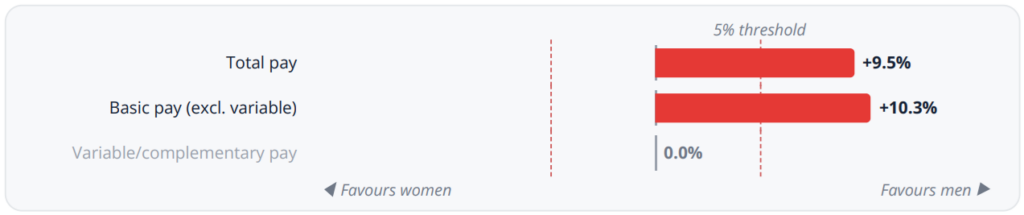
Management and worker representatives then review the pay data and job evaluations together to find out why the gap exists, such as biased salary bands or unfair hiring offers. Together, both sides must draft a Remediation Action Plan that:
- Sets target pay increases to bring underpaid roles up to equal pay (without reducing anyone’s existing salary).
- Sets clear budgets and realistic deadlines to complete the adjustments.
- Updates recruitment and promotion rules so new gaps do not appear in the future.
Once both sides agree on the plan, you must share it with your employees and submit the official report to DIER within 10 working days. HR and worker representatives must then roll out the pay adjustments on time and monitor the results to make sure the gap is permanently closed.
Update Recruitment: Stop Asking for Salary History
Fair compensation starts at the hiring stage. Employers must update their daily hiring process in three key ways:
- Drop past salary questions: Stop asking applicants what they earned in previous roles, as this simply carries past pay bias into your company.
- Handle salary expectations properly: While asking about past pay is prohibited, asking candidates for their forward-looking salary expectations is still allowed in Malta. However, you must ensure any offer is anchored to your internal salary scale and the role’s objective value, not individual negotiating leverage. You must disclose the starting pay rate or salary scale before the recruitment process concludes.
- Use neutral job adverts: Review all job descriptions and job titles to make sure they are strictly gender-neutral and do not unintentionally discourage applicants.
Managing Daily Compliance and Deadlines
The 8-Day Rule for Employee Pay Inquiries
Workers have the legal right to ask for their pay information in writing. This includes their personal pay level as well as the average pay for colleagues doing the same job or work of equal value, broken down by gender.
Employers must be ready to respond quickly under strict statutory deadlines:
- The 45-Day Escalation: Once escalated, the business has a total of 45 calendar days from the date of the original request to provide the data. Failing to respond within 45 days escalates the matter to a criminal offence, exposing the business and its directors to statutory fines.
- The 8-Day Clock: You have 8 calendar days to provide the written pay information. If you miss this deadline, it counts as an administrative non-compliance, and the employee or their representative can escalate the issue to DIER.
Preparing for Malta’s Pay Gap Reporting Deadlines
Official reporting deadlines are phased in over several years based on the number of workers you employ:
| Workforce Size | First Report Deadline | Financial Year Covered |
| 150+ Workers | 7 June 2027 | 1 Jan – 31 Dec 2026 |
| 100–149 Workers | 7 June 2031 | 1 Jan – 31 Dec 2030 |
For employers with 150 or more workers, tracking your 2026 payroll data accurately is essential, as this calendar year forms the baseline for your first mandatory filing in June 2027.
Technology Integration & Salary Scales: Ensuring Day-to-Day Workflow Readiness
Managing Pay Governance with Talexio
Trying to track salary scales, role grades and pay equity manually using spreadsheets is slow and open to human error. Using dedicated HR software built around Maltese employment regulations makes staying compliant much easier.
Talexio provides the operational architecture required under the EU Pay Transparency Directive by anchoring every job grade, step and variable allowance to objective, gender-neutral criteria:
- Automated salary scales: Talexio’s Pay Management Module lets you set up clear salary bands, giving everyone a transparent view of fair compensation.
- Pay equity toolkit: You can easily convert part-time and full-time pay into full-time equivalent (FTE) numbers for fair comparisons. It automatically tracks gender pay gaps across basic pay, bonuses and allowances.
- Early risk alerts: Rather than waiting for annual reporting deadlines, Talexio continuously monitors equity across every job grade and salary scale, alerting you whenever a pay gap hits or crosses the 5% threshold so you can address it within the six-month window.
Setting up structured salary scales today does more than tick a legal box for DIER, it gives your business a clear, reliable framework long before an employee inquiry or audit deadline lands on your desk. When compensation is objective, transparent and built into your everyday workflows, your organisation stays audit-ready and protected against unexplained pay gaps.
Disclaimer: This article is provided for informational purposes only and does not constitute formal legal advice. Organisations should consult qualified employment legal counsel for guidance regarding specific compliance obligations under Maltese law.

About the author
Kane Valletta is an HR Business Partner at KonnektTalexio, leading people operations across their Malta and Cyprus branches. He focuses on driving high-value, culture-first environments that bridge the group’s Recruitment heritage and HR technology.