
Malta’s Pay Transparency Law: What Employers Must Do Now
Malta’s Equal Pay (Transparency and Reporting) Regulations 2026 (Legal Notice 173 of 2026) came into force this year, bringing the country’s employment law into line with the EU Pay Transparency Directive. The rules apply to employers across the private and public sectors and introduce new obligations around pay transparency, equal pay and gender pay gap reporting.
In short, employers must ensure equal pay for equal work or work of equal value, disclose the initial salary or salary range during the recruitment process, stop asking candidates about their pay history and document how pay decisions are made. Employers with 100 or more employees also face gender pay gap reporting obligations, introduced on a staggered timeline between 2027 and 2031. Non-compliance can result in fines of up to €7,000 and, in some disputes, shift the burden of proof onto the employer.
This guide explains what the new law means in practice, which employers are affected, what information must be reported, and the steps HR teams can take now to prepare.
Is your business affected?
Every employer in Malta must comply with the equal pay principle, regardless of the size of the business. What changes as organisations grow is the level of reporting and documentation required.
| Headcount | Obligation | First report due |
| 250+ employees | Annual Pay Gap Report | 7 June 2027, then every year |
| 150–249 employees | Pay Gap Report every three years | 7 June 2027, then every 3 years |
| 100–149 employees | Pay Gap Report every three years | 7 June 2027, then every 3 years |
| 25–99 employees | No formal report, but must document pay-setting criteria internally under reg 5(2) | – |
| Under 25 employees | No mandatory Pay Gap Report | – |
All employers remain subject to the applicable equal-pay and pay-transparency obligations. Requirements concerning written pay-setting and pay-progression criteria vary according to workforce size. See regulations 3–6 and 9 of the Equal Pay (Transparency and Reporting) Regulations, 2026.
What the law requires
Although gender pay gap reporting receives the most attention, several obligations apply to employers of all sizes.
- Equal pay structures: Employers must have pay structures that make it possible to demonstrate that people doing equal work, or work of equal value, are paid fairly and consistently.
- No pay history questions: Hiring managers can no longer ask candidates what they currently earn or what they earned in previous roles.
- Salary transparency during recruitment: Candidates have the right to know the initial salary or salary range for a position, helping them make informed decisions before accepting an offer.
- Gender-neutral job ads and titles: Job advertisements, job titles and recruitment processes must be gender-neutral and free from discrimination.
- Written, accessible pay criteria: Employers must clearly document how they decide pay, pay levels and pay progression, using objective and gender-neutral criteria based on skills, effort, responsibility and working conditions. These rules must be available to employees at all times, although different requirements apply to employers with fewer than 50 workers.
Employee rights and response deadlines
Employees have the right to request information about their own pay and the average pay of people doing the same work, or work of equal value, broken down by sex.
The law sets clear deadlines for employers to respond.
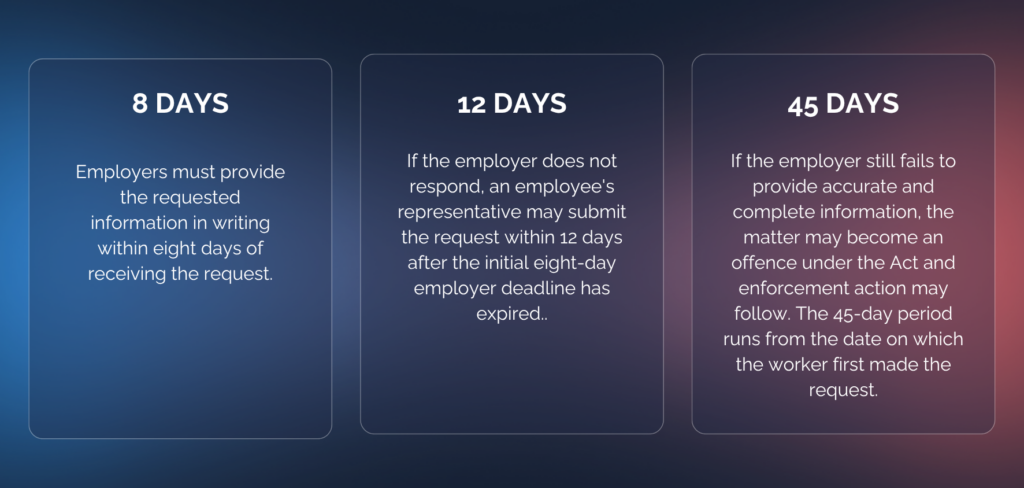
Employers must also inform all employees, at least once a year, that they have the right to request this information.
In practice, this means HR teams should have a clear process for receiving, reviewing and responding to pay information requests well before the deadline expires.
Gender pay gap reporting: what must be included
Employers that meet the reporting thresholds must submit a Gender Pay Gap Report containing information that shows how pay differs between female and male employees across the organisation.
The report includes:
- The overall gender pay gap.
- The gender pay gap for bonuses, allowances and other variable pay.
- The median gender pay gap.
- The median gap for bonuses and other variable pay.
- The proportion of female and male employees receiving bonuses or other variable pay.
- The proportion of female and male employees within each pay quartile.
- The gender pay gap for each category of worker, separated into basic pay and variable pay.
Reports must be submitted to the Department for Industrial and Employment Relations within 14 working days after the end of the relevant reporting period.
While employers may choose to publish their headline gender pay gap figures on their website, they must provide the detailed breakdown by employee category to their employees and employee representatives.
Joint Pay Assessment: when it becomes mandatory
A Gender Pay Gap Report is not the end of the process. In some cases, employers must carry out a Joint Pay Assessment.
This becomes mandatory when all three of the following apply:
- The Gender Pay Gap Report identifies a pay gap of at least 5% between female and male employees within a category of workers.
- The employer cannot objectively justify that difference.
- The difference is not addressed within six months of submitting the report.
Where these conditions are met, the employer must carry out a Joint Pay Assessment together with employee representatives, evaluating roles through a point factor job evaluation method.
The assessment examines:
- the proportion of female and male employees in each category;
- the average pay differences between them;
- the reasons for those differences; and
- the actions needed to eliminate any unjustified pay differences.
If agreement cannot be reached, the dispute may proceed through conciliation and, ultimately, to the Industrial Tribunal.
For employers, the important deadline is not simply the reporting date. It is the six-month period that follows. If a report identifies an unexplained pay gap, employers have that time to investigate, justify or correct it before a Joint Pay Assessment becomes mandatory.
Enforcement and penalties
The Equal Pay (Transparency and Reporting) Regulations introduce significant legal and financial consequences for employers that fail to comply.
The burden of proof shifts to the employer
In an equal pay claim, once an employee presents facts suggesting discrimination, the employer must prove that no pay discrimination took place.
If the employer has not complied with its pay transparency obligations, the burden of proof also falls on the employer, unless the breach was clearly unintentional and minor.
Financial penalties
The general fine is between €2,500 and €5,000. Where regulation 20(2) applies to an offence connected with a breach of the equal-pay principle on the basis specified in that provision, the fine is between €5,000 and €7,000.
Compensation claims
Employees may be entitled to more than unpaid wages. Compensation can also include lost career opportunities and non-material damage, depending on the circumstances of the case.
Three-year limitation period
Employees have up to three years from the date they knew, or could reasonably have been expected to know, about a breach to bring a claim.
Three-year limitation period
Workers who exercise their rights under the Equal Pay Regulations are protected against retaliation. Employers must not victimise employees or their representatives for requesting pay information, raising concerns about equal pay, or taking part in proceedings related to an alleged breach of the regulations.
Employer readiness checklist
With the Equal Pay Regulations now fully in force, workers already hold the legal right to request pay data. Even if your company’s formal reporting timeline is phased, reviewing pay practices should start now.
- Review existing pay structures and identify any unexplained differences in pay.
- Remove questions about previous salary from recruitment processes and application forms.
- Make sure candidates receive salary or salary range information during the recruitment process.
- Document the objective criteria used to determine pay, pay progression and job levels based on skills, effort, responsibility and working conditions
- Create a clear process for responding to employee pay information requests within the required timeframe.
- Introduce a structured, gender-neutral job evaluation methodology. Our Point Factor Job Evaluation Guide explains how you can use Talexio to run the evaluation.
- Identify when your organisation will become subject to gender pay gap reporting and begin collecting the necessary data in advance.
- Prepare a process for carrying out a Joint Pay Assessment should it become necessary.
- Review employment contracts, policies and employee handbooks to ensure they reflect the new rights and protections.
- Train HR teams, recruiters and managers on the new legal requirements.
- Assign ownership of pay transparency compliance and review progress regularly.
How Talexio supports pay transparency compliance
Meeting the new requirements depends on having accurate pay, job and employee data in one place. When information is spread across spreadsheets, employment contracts and email conversations, responding to employee requests or preparing reports becomes significantly more difficult.
Talexio brings together employee records, job structures, reporting, document management and audit history in a single HR platform, making it easier to manage pay transparency obligations.
Job Library
Store job descriptions, grades, competencies and pay frameworks in one central location, giving HR teams a consistent foundation for pay decisions. It also supports structured job evaluation. Learn more in our Point Factor Job Evaluation Guide.
Employee Self-Service
Employees can securely access their own employment information, while HR teams can respond to formal pay information requests more efficiently.
Reporting
Generate the information needed for gender pay gap reporting, including pay gaps, median pay differences, pay quartiles and variable pay analysis, without manually combining data from multiple sources.
Audit Logs
Every important HR and pay-related change is recorded with a timestamp, creating an audit trail that helps employers demonstrate how decisions were made.
Document Management and e-Signature
Distribute updated policies, collect acknowledgements electronically and maintain a clear record that employees have received important documentation.
These features are included as part of the HR & Leave module, helping employers prepare for pay transparency requirements without purchasing additional compliance modules.
You can explore everything included on our pricing page.
Frequently Asked Questions
Yes. The equal pay principle applies to every employer in Malta, regardless of size. While only employers with 100 or more employees must submit Gender Pay Gap Reports, smaller employers must still provide equal pay for equal work or work of equal value, avoid asking about salary history and document how pay decisions are made where required.
Reports must be submitted according to the deadlines set for each employer size: 7 June 2027 for employers with 150 or more workers, and 7 June 2031 for employers with 100–149 workers. The Regulations also refer to submission within 14 working days from the end of the relevant yearly period, so employers should follow any reporting guidance issued by the Monitoring Body.
Before recruitment is completed, candidates must receive information about the initial salary or salary range for the role, based on objective and gender-neutral criteria. Employers must also provide information about any relevant collective agreement provisions. Employers can no longer ask applicants about their current or previous salary.
Yes. Employees have the right to request information about their own pay and the average pay of employees doing the same work, or work of equal value, broken down by sex. Employers must respond within the statutory deadline.
A Joint Pay Assessment is a formal review carried out by an employer together with employee representatives when an unexplained gender pay gap remains after reporting. The assessment examines the causes of the gap and identifies measures needed to address any unjustified differences.
Non-compliance can result in financial penalties, compensation claims and, in some cases, a shift in the burden of proof to the employer in discrimination proceedings. Employers may also be required to justify their pay practices before the relevant authorities or the Industrial Tribunal.
The best place to start is by reviewing pay structures, documenting how pay decisions are made, introducing a consistent job evaluation methodology, updating recruitment processes and ensuring HR systems can produce the information required by the Regulations.
Talexio helps employers manage pay transparency obligations by bringing together employee records, a job evaluation tool, job structures, reporting, document management and audit history in one HR platform. Features such as Job Library, Employee Self-Service, reporting and document management make it easier to prepare for reporting, respond to employee requests and maintain consistent pay processes. Learn more about the HR & Leave module.
Disclaimer: This article is provided for informational purposes only and does not constitute formal legal advice. Organisations should consult qualified employment legal counsel for guidance regarding specific compliance obligations under Maltese law.

About the author
At Talexio, Jonathan Camilleri works closely with legal advisors on employment compliance, including Malta’s pay-transparency obligations. He leads Talexio’s work on employee engagement measurement (Team Voice) and HR people-data. He reviews Talexio’s compliance content for accuracy.