
Work of Equal Value: A Business Leader’s Guide to Malta’s Pay Transparency and Reporting Regulations
This guide is intended as general information and does not constitute legal advice. For advice specific to your organisation, consult a qualified employment lawyer.
Under the Equal Pay (Transparency and Reporting) Regulations in Malta, business leaders and HR managers must update how staff pay is set, reviewed and explained. Moving from basic compliance to a clear pay structure allows businesses to build a compensation system that remains easy to defend during official reviews.
Evaluating work of equal value requires employers to compare distinct positions across four objective, gender-neutral criteria: Skills and Qualifications, Effort, Responsibility and Working Conditions. Where an unexplained gender pay gap of 5% or more exists within a worker category and remains unresolved for six months, employers face mandatory Joint Pay Assessments and statutory financial penalties between €2,500 and €5,000.
Understanding Work of Equal Value in Practice
The Legal Distinction Behind Work of Equal Value
Under Malta’s 2026 regulations, detailed in our comprehensive guide on Malta’s Pay Transparency Law: What Employers Must Do Now, employers must guarantee equal pay for work of equal value across their entire organisation, expanding beyond simple equal work:
- Equal Work: Applies strictly to positions performing identical or nearly identical daily tasks, such as two payroll administrators working within the same team.
- Work of Equal Value: Applies to completely different roles that contribute equivalent worth to the business based on clear, objective standards.
For example, an IT support technician and a storekeeper carry out entirely separate duties. However, although these roles are different, they might carry the same organisational value under Maltese employment law. When two distinct roles are identified as having equal value, the employer is legally required to assign them identical, objective pay structures.
Evaluating Roles Through Four Objective Criteria
Maltese employment regulations state that job evaluations must use four gender-neutral criteria to assess positions fairly across a company:
| Evaluation Criterion | Assessment Scope | Practical Application under Maltese Guidelines |
| Skills & Qualifications | Required professional knowledge, formal credentials, practical experience and soft skills. | Evaluates formal degrees, trade certifications, specialised technical expertise and key interpersonal competencies. |
| Effort | Mental, physical and emotional demands placed upon the employee. | Measures cognitive problem-solving, physical exertion and psychological strain. |
| Responsibility | Decision-making scope, financial oversight and staff management duties. | Assesses budgetary control, direct reports and operational risk exposure. |
Working Conditions | Physical environment, psychological stress and workplace safety risks. | Evaluates environmental hazards, noise exposure and high-stress working environments. |
Deciding what percentage weight to assign each criterion depends heavily on organisational context. When criteria exhibit high discrepancies across departments, such as contrasting desk-bound IT specialists with physical warehouse operators, those differentiating criteria require higher relative weightings than in organisations where variances across positions are minimal.
To measure these four areas consistently, employers are advised to implement the Point-Factor Method. This approach grounds salary decisions in objective job requirements rather than individual employee traits or historical salary agreements.
A Step-by-Step Framework to Build an Auditable Pay Architecture
Step 1: Audit Roles to Identify Work of Equal Value
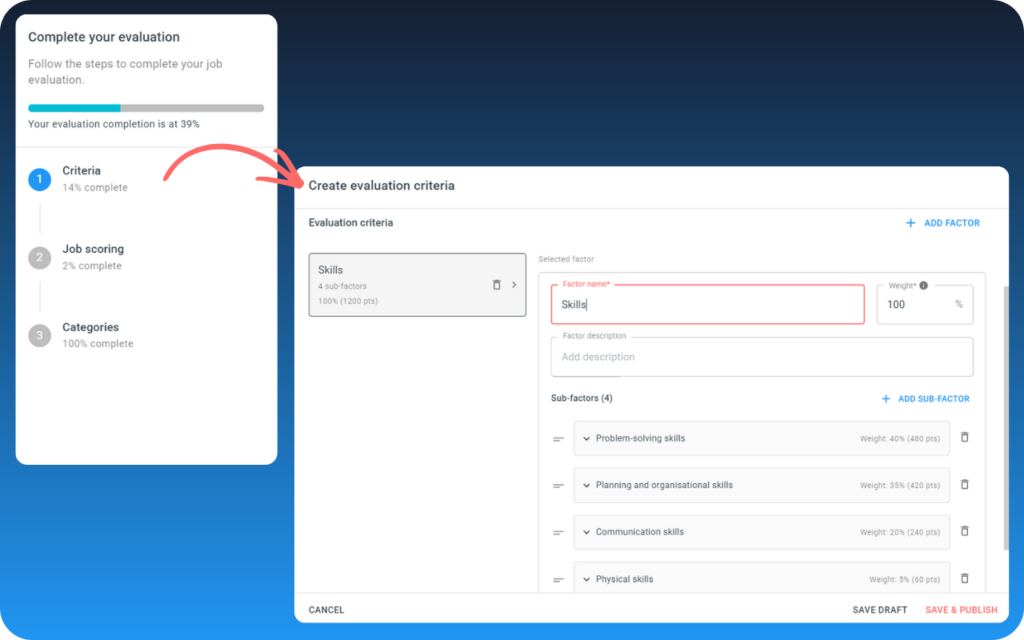
Building a fair pay framework begins by updating job titles and grouping roles into clear Job Families across the business. HR leaders must review job descriptions against the four core evaluation criteria rather than relying on job titles alone.
Objective evaluation tools help companies set weighted criteria, score active positions and place roles into consistent organisation-wide grade levels.
Step 2: Standardise Salary Ranges and Progression Rules
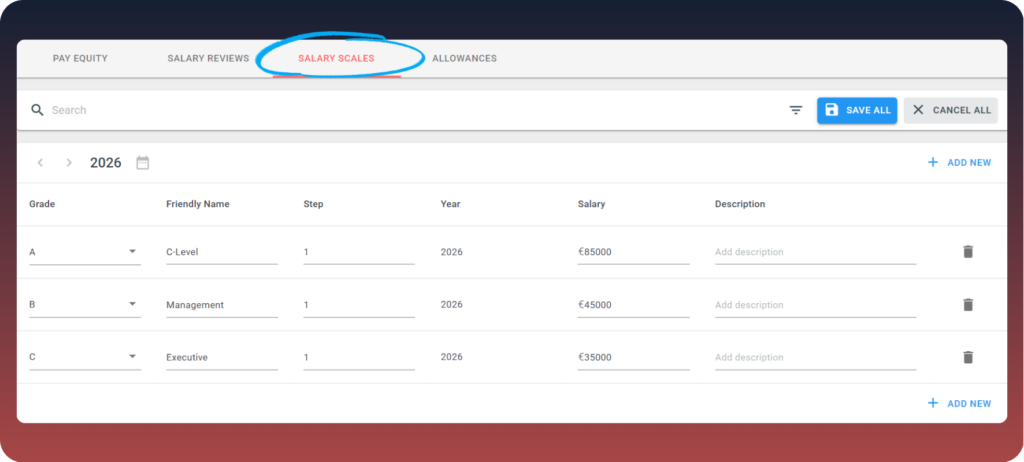
Employers are legally required to maintain written pay rules explaining how pay levels and pay rises are decided using objective standards.
Establishing clear salary bands and career progression steps removes personal manager discretion from pay decisions, creating a transparent, auditable structure across departments.
Step 3: Redesign Recruitment to Eliminate Salary History
Hiring workflows must be updated to align with current laws, starting with a strict ban on asking candidates about their current or past salary history. Employers must provide job seekers with the starting salary or salary range upfront, before concluding the recruitment process.
When handling pushback from line managers accustomed to using candidate salary history to negotiate lower job offers, note that the discussion has shifted from good practice to a legal mandate under Legal Notice 173 of 2026. Salary history inquiries are explicitly prohibited, meaning manager discussions must focus on aligning salary offers directly to the objective value of the job position rather than prior earnings.
Step 4: Establish an Efficient Employee Pay Request Protocol
HR departments need a simple internal workflow to receive, review and answer employee pay information requests within required legal deadlines. Additionally, companies must notify all employees in writing at least once a year regarding their statutory right to request pay information.
Standardisation plays a major role in streamlining this review process:
- Submission channels: Establish clear, centralised internal procedures for how and where requests are submitted.
- Automated insights: Implement technology like Talexio that facilitates rapid data acquisition and automated pay gap insights.
- Statutory adherence: Process inquiries within legally stipulated timeframes, ensuring complete data accuracy and fairness without overwhelming daily HR operations.
Hidden Risks in Determining Work of Equal Value
Why Organic Salary Growth Creates Unintended Pay Gaps
Unplanned pay gaps often develop across similar job groups over time due to historical salary negotiations, informal job offers and varying management styles.
Under the Equal Pay (Transparency and Reporting) Regulations, the legal burden of proof shifts directly to the employer. If an employee presents basic details suggesting unfair pay, the employer must legally demonstrate with objective data that no pay discrimination took place.
From our experience, Maltese employers frequently make critical classification errors when grouping roles into Job Families for equal value comparisons:
- Grouping by hierarchy instead of work value: Categorising roles strictly by seniority level rather than assessing actual operational contribution.
- Relying on outdated job specifications: Basing evaluations on legacy job titles rather than inspecting current job content and daily tasks.
- Disregarding cognitive effort and mental strain: Focusing exclusively on physical exertion while ignoring psychological stress and mental fatigue under Effort and Working Conditions.
Managing Data Risks During a Work of Equal Value Review
Under Maltese employment law, the statutory definition of pay includes:
- Gross basic salary
- Variable compensation and performance bonuses
- Overtime pay and shift allowances
- Statutory allowances and company benefits in kind (such as health insurance or company vehicles)
Because statutory pay encompasses such a wide range of monetary and non-monetary components, conducting a thorough Work of Equal Value review requires full visibility across your entire compensation structure. When these diverse data points are managed in silos, capturing and cross-referencing every element for comparable roles becomes inherently complex.
Storing pay records, job descriptions and offer letters across scattered spreadsheets creates significant operational and legal risks. Managing this information in separate files makes it difficult to respond when employees exercise their statutory right to request information regarding salary ranges and gender-disaggregated average pay figures for comparable roles. Manual tracking increases calculation error rates during audits and leaves HR teams unprepared for official compliance reviews.
Centralising Work of Equal Value Mapping with Talexio
Streamlining Compensation Architecture with the Pay Management Module
To mitigate the abovementioned risks, organisations require a unified ecosystem that serves as a single source of truth. Talexio addresses this directly through its HR module, which centralises job descriptions, contracts and multi-layered compensation structures within one organised platform.
By establishing a single, structured repository for all workforce data, Talexio eliminates the errors of manual tracking, allowing HR teams to configure sub-factor weightings across Skills, Effort, Responsibility and Working Conditions, to execute precise equal value reviews, respond swiftly to information requests and maintain effortless compliance.
From Manual Spreadsheets to Audit-Ready Confidence
Moving away from spreadsheets to an automated platform simplifies how organisations define, weight and evaluate roles to establish true Work of Equal Value:
- Objective factor weighting: Talexio allows HR teams to define job criteria and configure weighted sub-factors, such as Skills, Effort, Responsibility and Working Conditions, to build an unbiased, standardised baseline for every role.
- Consolidated role architecture: The platform automatically aggregates roles with equivalent point-factor scores into unified Work of Equal Value categories, eliminating reliance on arbitrary job titles or disconnected tracking files.
- Centralised score governance: Every evaluation decision, weighting update and job re-assessment is captured in a single location, building a transparent and searchable history of your organisational structure.
Keeping definitions, weightings and pay structures consolidated in one platform like Talexio eliminates human error, ensures ongoing compliance and keeps leadership teams confident and perpetually audit-ready.

About the author
Kane Valletta is an HR Business Partner at KonnektTalexio, leading people operations across their Malta and Cyprus branches. He focuses on driving high-value, culture-first environments that bridge the group’s Recruitment heritage and HR technology.