
Gender Pay-Gap Reporting in Malta: Building an Audit-Ready HR Process
As of 2026, Legal Notice 173 requires employers in Malta to carry out formal Gender Pay-Gap Reporting based on their workforce headcount, ensuring employees receive equal pay for work of equal value using objective, fair standards.
To build an audit-ready HR process, companies need to track pay gaps, monitor variable pay and fix unjustified pay differences over 5% to avoid joint assessments and penalties from the Department for Industrial and Employment Relations (DIER).
Timelines and Employer Headcount Thresholds
Malta’s official equal pay regulations introduce binding reporting rules that scale with company size. Instead of enforcing a single deadline for everyone, the law rolls out in stages so employers have enough time to set up structured, transparent pay systems.
| Workforce Headcount | Reporting Cadence | Initial Submission Deadline | Scope of Reporting |
| 250+ Employees | Annual | 7 June 2027 | Full 2026 Calendar Year Data |
| 150–249 Employees | Triennial (Every 3 Years) | 7 June 2027 | Full 2026 Calendar Year Data |
| 100–149 Employees | Triennial (Every 3 Years) | 7 June 2031 | Full 2030 Calendar Year Data |
| Under 100 Employees | Exempt from Filing | N/A | Equal pay rules apply universally |
While businesses with under 100 employees do not have to submit official reports to the government, equal pay principles under the wider EU Pay Transparency Directive apply to all companies.
Organisations with over 50 employees must make their pay structures and career progression paths public to staff, while those with 25–100 employees must keep written internal records explaining their base pay structures.
Core Metrics Required for Gender Pay-Gap Reporting
Under Regulation 9(1)(a)–(g), qualifying employers must calculate and report key compensation metrics to the DIER, covering both basic wages and variable pay components:
- Basic wage and total remuneration gaps: Overall average and median gaps across basic salary, performance bonuses, shift allowances and non-payroll perks.
- Variable pay participation: The exact proportion of male versus female employees who receive bonuses, allowances, or other variable payments.
- Pay quartile distribution: The proportion of male and female employees across four equal pay bands, from the lowest earners to the highest earners in the company.
- Equal value category gaps: The specific gender pay gap between workers within the same category performing equal work or work of equal value.
A 5-Step Operational Roadmap for Gender Pay-Gap Reporting
To move from last-minute panic to complete audit readiness, HR leaders can follow a practical five-step process:
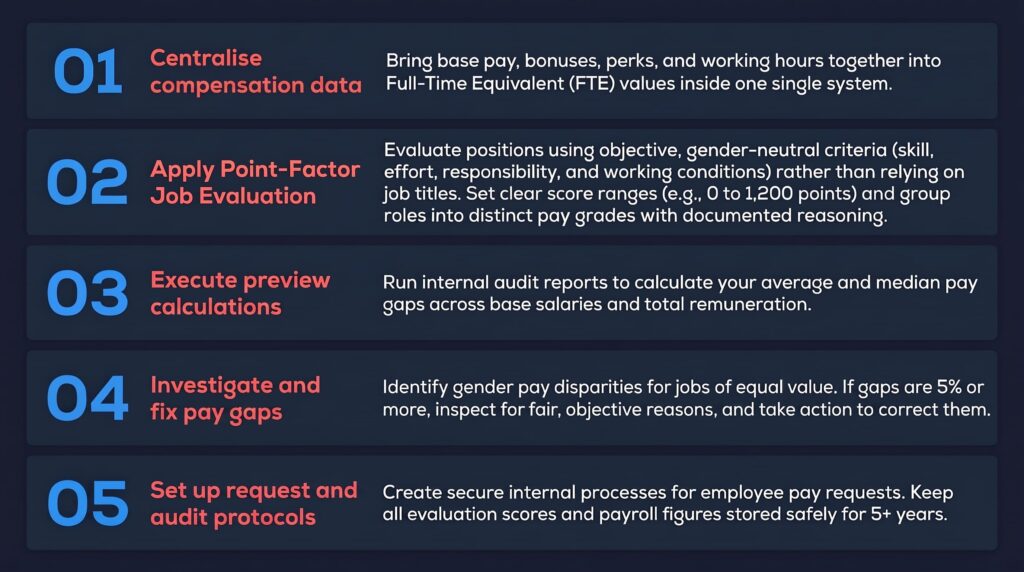
Because unjustified pay gaps carry the strictest penalties and tightest deadlines under Maltese law, knowing how to handle differences over 5% is the most critical part of this roadmap.
Unexplained 5% Pay Differences and Joint Assessment Risks
Resolving disparities within six months from the date of evaluation enables organisations to settle pay gaps internally, avoiding mandatory Joint Pay Assessments and statutory DIER fines between €2,500 and €5,000 (up to €7,000 for severe violations).
If an unjustified 5%+ gap remains unaddressed after six months, employers must legally initiate a formal Joint Pay Assessment by following these steps:
- Form the joint committee: Establish a joint committee with elected worker representatives, or hold fair staff elections if there are no representatives.
- Analyse data and identify root causes: Review gender pay data and job evaluations collaboratively to pinpoint the reasons behind the gaps, such as biased starting salary offers or uneven pay scales.
- Draft a Remediation Action Plan: Plan pay increases to raise underpaid roles up to equal pay (without reducing anyone’s salary), establish clear budgets and deadlines, and update recruitment and promotion policies to prevent future gaps.
- Distribute and submit the report: Share the agreed plan with employees and submit the official report to the DIER within 10 working days.
- Execute adjustments and monitor outcomes: Implement the scheduled pay adjustments on time and regularly review the results to ensure the pay gap is permanently eliminated.
The 8-Day Employee Pay Request Protocol
The Four-Step Administrative Workflow
Under Maltese law, employees have the legal right to ask for pay data for their job category, and employers must deliver a formal written response within 8 days. To handle these requests within the 8-day deadline while protecting staff privacy, HR teams should implement a simple four-step administrative process:
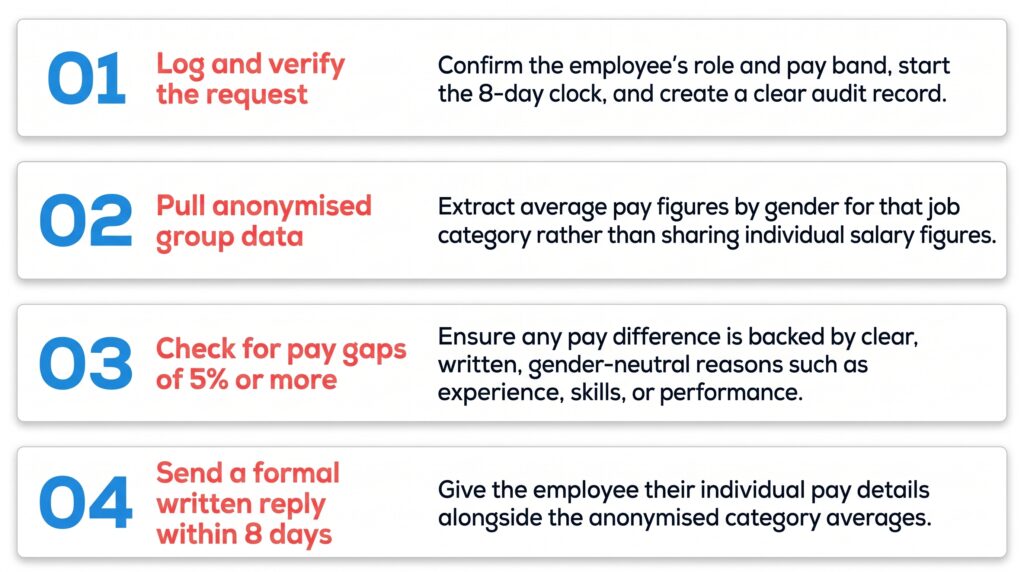
Keeping documented point-factor job evaluations helps HR teams answer requests quickly and provide clear evidence on pay gaps, quartile distribution and bonuses during official inspections.
Where Traditional Pay Systems Fail
Meeting an 8-day deadline is difficult when compensation records are scattered across separate spreadsheets, disconnected payroll tools and old emails. Calculating full-time equivalent (FTE) base pay, allowances, bonuses and perks manually takes too much time, invites human error and often hides pay gaps until an official inquiry arrives.
Bringing compensation data together into a single cloud-based HR platform removes these blind spots. Technology centralises all workforce data, turning the strict 8-day window from an operational strain into a calm, controlled routine.
Real-time visibility, automated pay-gap alerts and complete evaluation histories allow HR teams to resolve pay differences early, protecting the business from legal disputes, mandatory Joint Pay Assessments and DIER fines.
Integrating Pay Equity Standards into Daily HR Operations
Gender pay-gap reporting is not just an annual exercise. Companies must also make sure their everyday decisions around recruitment, pay reviews and promotions follow fair, consistent rules.
This starts with establishing clear salary ranges for different roles and explaining what employees need to accomplish to move up to higher pay levels. When hiring, employers should share salary bands with applicants upfront and avoid asking about their their past earnings.
HR teams should also regularly review how salaries are set and increased. Employees doing the same work or work of equal value should be paid fairly, and any differences must be supported by objective, gender-neutral reasons, such as relevant experience, skills or performance.
Managers play an important role in this process. They need clear guidelines for making salary offers, approving pay increases and promoting employees. Keeping records of these decisions helps companies explain pay differences, identify potential problems early and demonstrate compliance if questioned.
Automating Gender Pay-Gap Reporting with Talexio
Talexio’s Pay Management tools help companies manage fair pay practices, identify gender pay gaps and prepare for Malta’s reporting requirements. Instead of relying on spreadsheets and manual calculations, HR teams can manage the process in one place.
- Point-Factor job evaluations: Full-Time Equivalent (FTE) salary data is directly paired with job evaluation scores to calculate gender pay gaps across roles of equal value.
- Gender pay-gap alerts: Automated alerts instantly flag roles of equal value whenever a pay gap reaches or exceeds 5%.
- Comprehensive pay reporting: Pay gaps are calculated across basic salaries and total remuneration, including variable pay and perks.
- Indisputable audit trail: Complete scoring histories and centralised employee records ensure full transparency and clear evidence for legal submissions to the DIER.
See What a Gender Pay-Gap Audit Report Looks Like
Talexio’s Pay Equity Audit Report gives HR teams a clear overview of gender pay differences across the organisation. It includes overall pay gaps, salary quartile distributions, comparisons between jobs of equal value and an assessment of how consistently salaries reflect job responsibilities.
The report also highlights pay differences that need further investigation and recommends actions to help companies prepare for Malta’s reporting requirements.
Download the Sample Pay Equity Audit Report to explore an example based on a fictitious company.
Disclaimer: This article is provided for informational purposes only and does not constitute formal legal advice. Organisations should consult qualified employment legal counsel for guidance regarding specific compliance obligations under Maltese law.

About the author
Kane Valletta is an HR Business Partner at KonnektTalexio, leading people operations across their Malta and Cyprus branches. He focuses on driving high-value, culture-first environments that bridge the group’s Recruitment heritage and HR technology.